A plain-English resource for Shawnee home sellers who want to go it alone and do it rightI’m a REALTOR®. I make my living helping people buy and sell homes in Shawnee and Central Oklahoma.

Dated: April 24 2024
Views: 285
If you’ve been keeping up with the news lately, you’ve probably come across some articles saying the number of foreclosures in today’s housing market is going up. And that may leave you feeling a bit worried about what’s ahead, especially if you owned a home during the housing crash in 2008.  The reality is while increasing, the data shows a foreclosure crisis is not where the market is headed. Here’s the latest information stacked against the historical data to put your mind at ease.
The increase the media is calling attention to is a little bit misleading. That’s because it’s comparing the most recent numbers to a time when foreclosures were at historic lows. And that unfair comparison is making it sound like a much bigger deal than it actually is. Back in 2020 and 2021, there was a moratorium and forbearance program that helped millions of homeowners avoid foreclosure during the challenging times of the global COVID-19 Pandemic. That’s why numbers for just a few years ago were so low. Now that the moratorium has ended, foreclosures are resuming and that means numbers are rising. But it’s an expected increase—not a surprise—and not a cause for alarm. Just because foreclosure filings are up doesn’t mean the housing market is in trouble. To prove that to you, let’s expand the comparison out a bit more. Specifically, we’ll go all the way back to the housing crash in 2008, since that’s what people worry may happen again. The graph below uses research from ATTOM, a property data provider, to show foreclosure activity has been consistently lower since the crash in 2008: 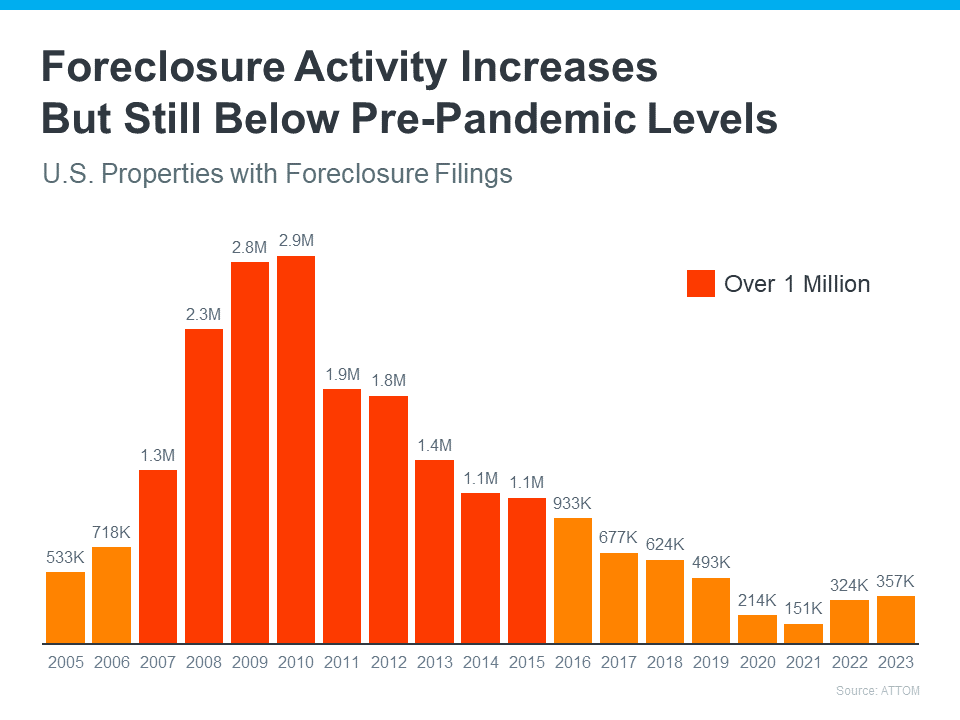 The data shows that things now aren’t anything like they were surrounding the housing crash. The bars in red are when there were more than 1 million foreclosure filings a year. In 2023, there were roughly 357,000. That’s a big difference. A recent article from Bankrate explains one of the reasons things aren’t like they were back then:
“In the years after the housing crash, millions of foreclosures flooded the housing market, depressing prices. That’s not the case now. Most homeowners have a comfortable equity cushion in their homes.”
Basically, foreclosure activity is nothing like it was during the crash. That’s because most homeowners today have enough equity to avoid foreclosure. And that’s a really good thing for homeowners and for the market. The reality is, the data shows a foreclosure crisis is not where the market is today or where it’s headed.
Right now, putting the data into context is more important than ever. While the housing market is experiencing an expected rise in foreclosures, it’s nowhere near the crisis levels seen when the housing bubble burst, and that won’t lead to a crash in home prices. Do you have more questions or would like to discuss it further? Hit me up! Call/text 405-585-6580 or email Hello@SoldonShawnee.com.

With 30+ years of experience in Oklahoma real estate, I help buyers, sellers, and rightsizers make smart, meaningful moves in Shawnee, OKC, and across Central Oklahoma. I combine deep market expertise....
A plain-English resource for Shawnee home sellers who want to go it alone and do it rightI’m a REALTOR®. I make my living helping people buy and sell homes in Shawnee and Central Oklahoma.
Once your home is under contract, we move into the inspection period outlined in the Oklahoma Uniform Residential Sale Contract. This is a normal phase of the transaction. Knowing how it works ahead
If you only followed national housing headlines in 2025, you probably heard a lot of noise. Interest rates. Market slowdowns. Buyer hesitation. Depending on the week, the story swung from &ldquo
Real Estate Beyond the ScoreboardEvery January, real estate social feeds start to look the same. Photos of plaques. Rankings. Sales awards. Captions celebrating volume and thanking clients and
 Copyright© 2026 MLSOK, Inc. listing content is believed to be accurate but is not guaranteed. Subject to verification by all parties. The listing information being provided is for consumers personal, non?commercial use and may not be used for any purpose other than to identify prospective properties consumers may be interested in purchasing. This listing data is copyrighted and may not be transmitted, retransmitted, copied, framed, repurposed, or altered in any way for any other site, individual
and/or purpose without the express written permission of MLSOK, Inc. Information last updated on September 23, 2026 12:07 PM UTC
© 2026 OKC Metropolitan Association of REALTORS® (OKMAR). All rights reserved.
Disclaimer: All information deemed reliable but not guaranteed and should be independently verified. All properties are subject to prior sale, change or withdrawal. Neither listing broker(s) nor September 23, 2026 12:07 PM UTC shall be responsible for any typographical errors, misinformation, misprints and shall be held totally harmless.
Data last updated on September 23, 2026 12:07 PM UTC
Show More...
Copyright© 2026 MLSOK, Inc. listing content is believed to be accurate but is not guaranteed. Subject to verification by all parties. The listing information being provided is for consumers personal, non?commercial use and may not be used for any purpose other than to identify prospective properties consumers may be interested in purchasing. This listing data is copyrighted and may not be transmitted, retransmitted, copied, framed, repurposed, or altered in any way for any other site, individual
and/or purpose without the express written permission of MLSOK, Inc. Information last updated on September 23, 2026 12:07 PM UTC
© 2026 OKC Metropolitan Association of REALTORS® (OKMAR). All rights reserved.
Disclaimer: All information deemed reliable but not guaranteed and should be independently verified. All properties are subject to prior sale, change or withdrawal. Neither listing broker(s) nor September 23, 2026 12:07 PM UTC shall be responsible for any typographical errors, misinformation, misprints and shall be held totally harmless.
Data last updated on September 23, 2026 12:07 PM UTC
Show More...
